
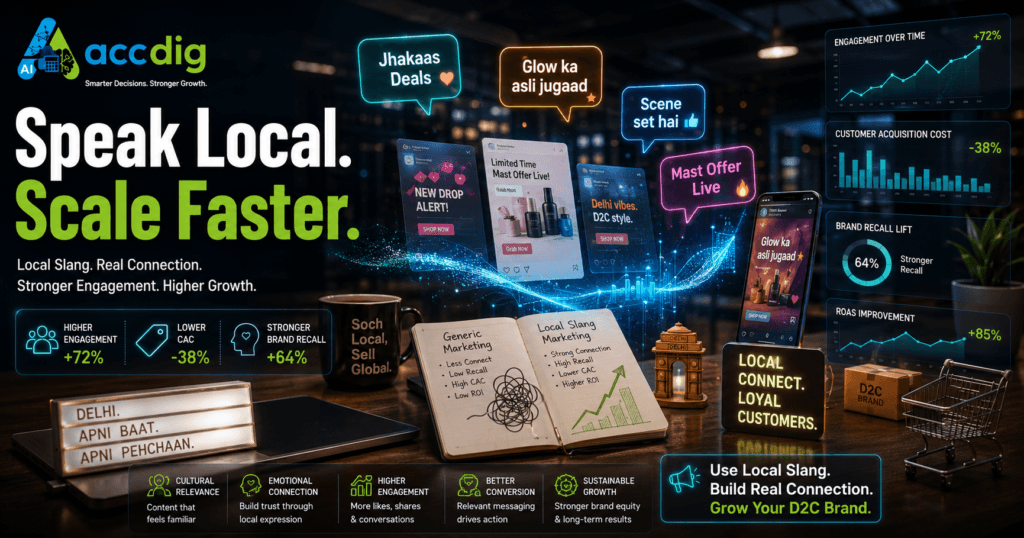
Local Slang Marketing: The Secret Handshake of Modern Marketing
All of them have their own rules of the road which are tacit – these are the jokes and infantile expressions that are not known to the outsider. It’s not just about the words when it comes to marketing, it’s about the trust.
Local Slang is a secret handshake that your company can use with your target consumers. There’s no place like it if you know it. If not, you’re simply selling.
Now this falls into the D2C marketing’s sight.
The skincare company having the following slogan is an asli ka asli jaad is, doesn’t an adverts this kind of a company, it talks.
As a psychology of an Indian consumer I have faced this for 20 years and this is one thing that has been foremost in my mind:
The local sounding ones require shorter construction times.
It’s not about using slangs in the text to “have a little fun” it’s about knowing the measurable impact of the language aspects, as they relate to the business, in the culture.
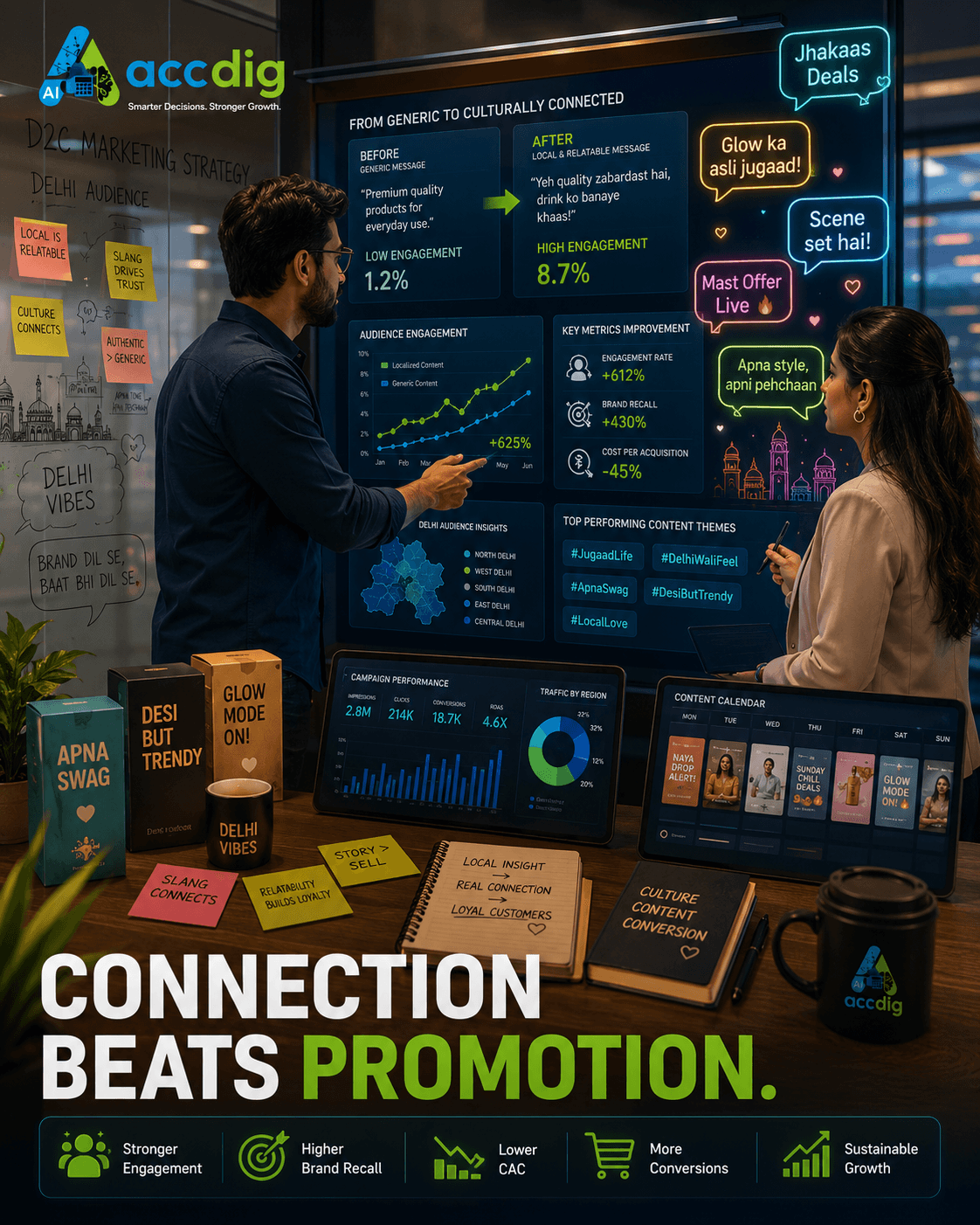
The Psychology of the Connection by why Local Slang Marketing Works.
Language = Identity
People aren’t merely talkers, they expel it. The appearance of an effect of similarity is to match your tone to the tone of the people you’re talking to; and the similarity effect is one of the most successful biases that makes people believe what is familiar when familiar.
This is in this regard, Kantar India (2023) reported that the campaigns which are assisted and supported by local language or local slang can be recalled, and actively involved 25-30 times more.
Emotional Recall kills Rational Recall.
Numbers don’t lie, emotions make a difference.
Local jargon can be exceedingly both sweet and vulnerable and a sense of kinship, a jolt to emotional authenticity.
The Authenticity Premium
It is not as frictional nor retentive in the natural language.
That needs to be human, in order to bring down Customer Acquisition Cost (CAC) and maximize Lifetime Value (LTV).
Marketers dream it and CFOs feel secure in its comfort zone.
Finance x Marketing: Cultural Relevance ROI.
Cultural Relevance ROI is a joint effort by the two teams. Cultural Relevance ROI is a product of the collaboration between the two teams.
It’s here where personalities are refined.
The idea of local slang marketing may sound like a dreamy choice – but it’s a choice that’s shrouded in a financial sense.
As per the report of McKinsey India (2023):
Individual ads on a culturally tailored content are better than standard ads (26.
The reduction of CAC of tone aligned brands is 12%.
The share of non-metro in India’s digital growth has increased from 60% to over 70% of the total growth in the digital space (NITI Aayog Digital Index).
When selling the words of people, you are not only receiving likes- you are saving on the purchasing expenses.
Mini Case Learning of Indian D2C Brands.
Case 1: The Skincare Startup That Found Its Voice.
Habitual message: Made and tested: Our new Vitamin C collection: To have radiant skin.
New Headline: “Glow ka asli jugaad–our Vitamin C range.
Results: an increase in engagement after 10 days.
One word that encapsulated one factor of the jugaad was this one word – ‘culture, humor and relatability.
Case 2: The Snack Brand that Went Viral.
Old labellage: “New Spicy Flavor Launched.’
Rerelease: No need to worry about having fat taste, lock masala.
Outcome: 40 percent growth in organic followers in 3 months time- no extra expenditure has to be incurred on adverts.
There is no culture fuse, budget etc., but culture belonging.
The Local Slang Spectrum: Finding Sweet Spot in a Brand.
The Local Slang Spectrum shows that cultural communication is not a one-size-fits-all strategy. Brands can gradually increase localization based on audience preferences, market maturity, and brand positioning.
At the first stage, Soft Localization, brands add subtle Hinglish cues such as “Bhai, offer live hai!” This approach works well for premium or formal brands that want to sound more relatable while maintaining professionalism.
The second stage, Everyday Slang, uses familiar Indian expressions like “Mast deals for a mast weekend.” It helps youth-focused and mass-market brands create stronger engagement and improve relatability.
The third level, Regional Flair, introduces state-specific language such as “Asli taste, ekdum jhakaas!” This strategy is particularly effective for connecting with Tier-2 and Tier-3 audiences.
At the deepest level, Deep Immersion, brands embrace culturally rooted phrases like “Garam chai pe gossip wali vibe.” This creates highly personalized experiences for hyperlocal campaigns.
For most startups, beginning with Levels 1 and 2 is often the safest and most effective approach. As audience understanding improves, brands can gradually experiment with Levels 3 and 4 to build stronger emotional connections.
5 Strategy Awkward Ideas to Implement Local Slang Marketing.
Microcopy That Speaks
Make sure to first appear on your chatbots, apps and notifications as replacement ‘Buy Now with Scene bana lo, abhi!‘.
Real-Sounding Social Storytelling.
Where you can use slangs, of course, you use them in captions and reels.
It is Friday ka scene? (Example: Friday’s scene? Create a new drop live haif.”
Perfection is secondary in that it is true to itself.
Cooperate with Local Influencers.
Coordinate with artists with natural local tint (NAT).
They’re also more credible than the larger influencer, and that’s not something that can be replicated.
A/B Test Tone Variation
Experiments: Formal/Informal.
Measuring clicks and interaction- there’s virtually no fud.
Build a Brand Playbook | Language.
Create a local slang guide that will be suitable to your brand.
This saves the conformity, malformation and mistreatment.
The Myths about Local Slang Marketing (And the Real Story).
Myth 1: “Local Slang seems not professional.”
→ Fact: The choice of words should be clear – it is not that professional.
Myth 2: “Local slang is only used by the Gen Z.”
→ Fact: That there is a shorthand in every generation–circumstance is more than age
Myth 3: “It will never scale”
→ Fact: It being able to scale perfectly well with region segmentation as well as dynamic content tools.
The ROI of Sounding Human
The ROI data clearly shows that sounding human is more than a branding choice—it directly impacts business performance. Brands that adopt localized and relatable communication often create stronger audience connections.
Engagement rates increase significantly with localized messaging. Traditional communication typically generates around 2–3% engagement, while culturally relevant and human-centered messaging can increase it to 5–9%.
Customer Acquisition Cost (CAC) also improves when brands sound more relatable. Localized communication can lower acquisition costs by 10–12% because audiences respond more positively to familiar language.
Retention improves when customers feel understood. While traditional messaging delivers average retention levels, localized tone can increase retention by nearly 1.5 times.
Organic sharing behavior also changes dramatically. Compared to traditional campaigns with low sharing rates, relatable messaging can generate 3–4 times more organic shares.
The broader insight is simple: language drives efficiency. The more customers feel that your brand understands them, the easier and more cost-effective it becomes to earn trust and influence decisions.
Frequently asked questions
Serious, but sounding like a human voice, make your brand message sound.
Speak language mixed with English and Hindi or local – code-mixed English.
Yes. Generate words as novel KPI-lift in rupee.
Final Reflection
Not that we should use the local vernacular but that we can’t.
Brands will win which have a similar but not exact sound to the market’s consumers in a saturated digital market.
If language is personal, it will be taken as implied.
Key Takeaways
The Local Slang supports and boosts both trust and recall.
When the finance and marketing teams are aligned, they become a driver of ROI.A finance–marketing alignment equals ROI driver.
The volume of the sounds scales better than when sounded by a human.The sounds sound at human scales rather than smart scales.
❌ Fake = higher CAC, lower retention
Looking to understand how content strategy can be used to make content more engaging and trustworthy?
Talk to the Digital Marketing Team at Accdig about a complimentary consultation to help with creating culturally relevant brand voice.