The project Free AI Courses in India 2025: Learn Artificial Intelligence Free: does not require spending money.
Educate Yourself without Paying to Education.
You do not even need to crack the lakhs to learn AI that you can pocket the affordations of the low-cost or even a free reputable web based programs and get the education that mostly comes with the certification. There are a number of free AI courses in india which are provided below:
NPTEL and SWAYAM
What are them?
Low-cost or free AI courses through online learning and other relevant issues have been embraced by IITs and IISc with government-sponsored programs offered in India to offer AI education.
NPTEL: Procured a collection of Artificial Intelligence material, something that was available at most tiers and in most narrow specialization areas, such as Artificial Intelligence and drug discovery, Artificial Intelligence and the law and supercharged Artificial Intelligence.
SWAYAM Plus (IIT Madras): The recently obtained free AI courses in India that were provided to the students, faculty and working professionals. Such courses are AI in physics, chemistry, accounting, sports analytics, and foundations of AI/ML in Python. There are no pre-requisites in AI or experience in coding. The courses meet the requirements of the National Credit Framework, and, potentially, the universities are able to accredit them.
Certification:
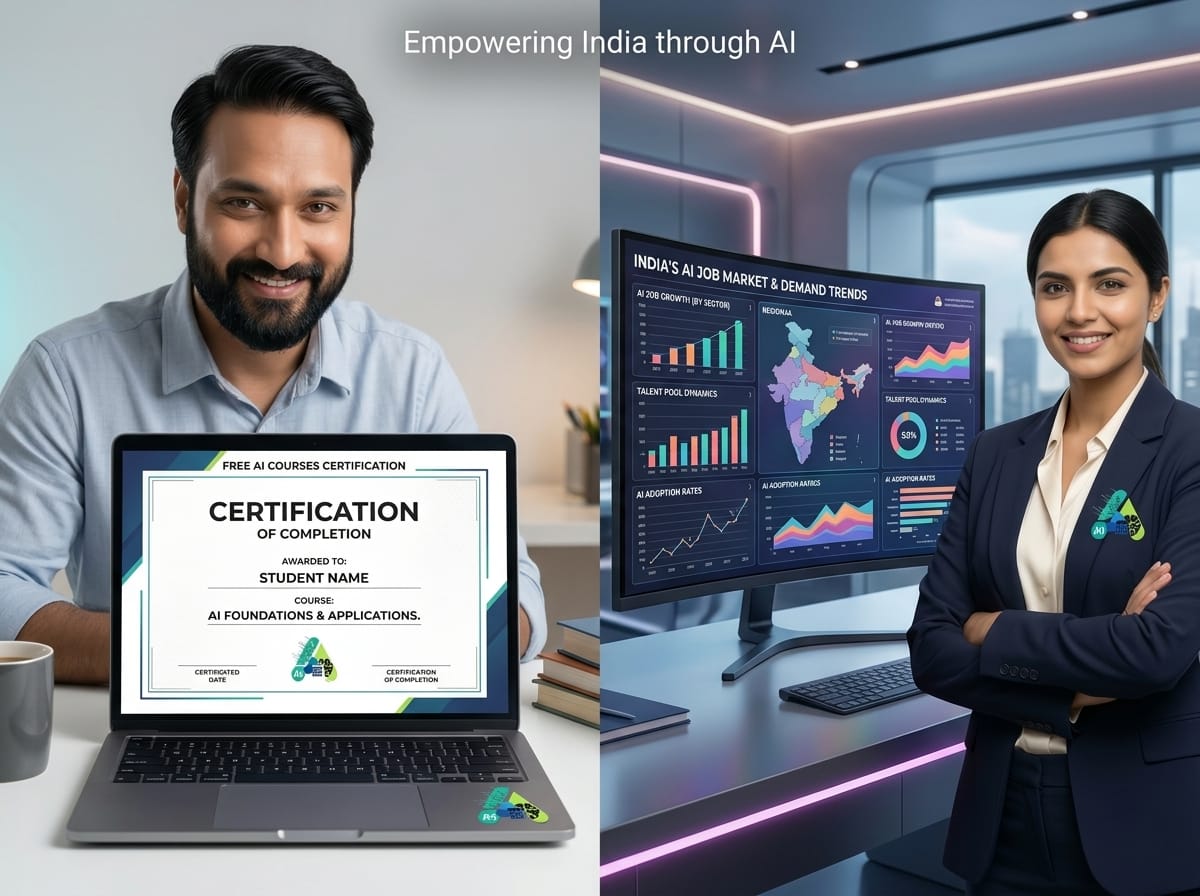
These courses are free and after passing an exam, they are able to receive the certificates at a minimal fee.
Who is welcome?
Anybody can get engineering, science, commerce, arts, and even students who are not techno savvy. No skills were required previously just digital literacy and the right spirit.
Google AI
What is it?
The free source is also an amateur platform that offers the topic of AI and machine learning.
What is the reason to use it?
It is an excellent introduction to AI to a beginner, including examples to work with and problems to solve. This is appropriate to fill the beginners.
Smartness of Microsoft Learning.
What is it?
The platform provided by Microsoft is a scenario-based and realistic AIs and machine learning modules.
What is the reason to use it?
Discusses the AI- industry use cases, business application and daily use case. Has step by step projects and laboratories.
IIT-AICTE AI Skills Program
What is it?
IITs and AICTE have a joint program known as a non-technical student specific program.
What is the reason to use it?
The courses are designed in such a way that they create the basics on how to use AI without previous knowledge about coding and can be more available to more people.
Pro Tip
Choose the one course. Finish it. Construct one plain project.
As an example, create ChatGPT API and Excel Resume Analyzer. This will place you under on-the-job learning and it is the quickest method of acquiring practical skills and competence.
In summary:
You can begin with your visit to AI in India without needing to make any hole in your pocket, these are all valid, available and all these are made according to the interest of the learners of all the levels of proficiency. Concentrate on reading course and rehearsing your knowledge in mini-project to study as much as possible.
Career Fields You From Never Knew Existed
One does not need a PhD to get into the AI space. Here are some results that make a good deal of sense:
| Role | What You Do | Who It’s For |
| AI Product Manager | Facilitate business requirements with AI tools | MBAs, engineers, UX enthusiasts |
| Prompt Engineer | Craft precise AI prompts for better results | Writers, coders, content creators |
| AI Tester/Verifier | Test AI outputs for accuracy, bias, legality | Law grads, testers, analysts |
| Data Curator | Prepare training data for AI | Freshers in data entry, librarianship |
Implementation & Action Plan for Indian Students & Freshers Wesley
Your 5 step guide of beginners is suitably located along with recommendations of national AI strategy of india and optimal recommendations of NITI aayog and government AI initiative.
Step 1: Select a sector where you are interested in.
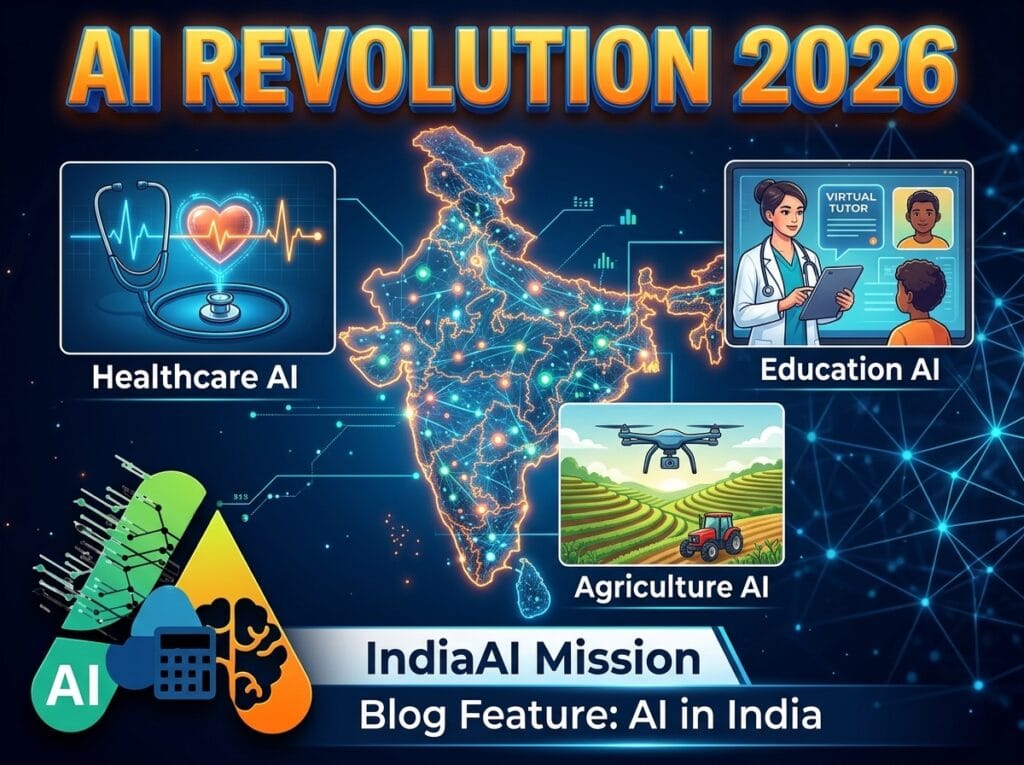
The concept of NITI Aayog National Strategy on Artificial Intelligence is founded on the notion of prioritizing the areas which would be strategic i.e. they comprise of healthcare, agriculture, education, smart cities, finance and infrastructure. It was concluded that AI is considered a radical in all these spheres and can possibly cause the evolution of the economy and social aspects.
Step 2: Technological Awareness of the transformation AI is bringing to it
The plan will prompt them to go an extra mile with the inexhaustible resources available to them e.g. Youtube, blogs, research papers, etc. to their quest for learning more about AI and the current trends in the industry of choice. This is self-directed learning which is brought about by high rate of technological change.
Step 3: Read a 1 course theoretically submitted ai beginner read model.
The AI road map of India has some of dimension such as skilling and reskilling. Technologically-aided courses (NPTEL, SWAYAM, AI for India 2.0) and industry collaborating are being provided in all (Irrespective of the background) and it is providing high quality affordable and accessible options to AI learning.
Step 4: Learn to build mini-project of what you have learnt.
The national strategy and AI missions encourage learning and practice, assume that projects and demonstration of ideas are the most efficient in verifying the solidification of the skills and evidences of the power.
Step 5: Debte the role of appearing in it (LinkedIn, GitHub, blog):
The similarity is that publicity of the projects goes hand in hand with the desire of the government to create successful AI-ecosystem and the culture of innovation and collaboration. This will make individuals become credible and identify with the larger community of AI.
Additional Details:
Inclusive approach: The AI strategy of India is based on AI for All mantra which means the nation is keen on becoming an inclusive nation, and the benefits of AI should not be consumed only by the representatives of the tech community.
Responsible AI: NITI Aayog has also issued the guidelines of ethics, transparency and responsible use of AI and asks the learners to think about the problem of bias, privacy and fairness to create and process the AI solutions.
Economic effects: NITI Aayog estimated that the artificial intelligence can bring up to 1 trillion dollars of a percentage to the Indian economy in the year 2035 and as people in other sectors embrace the change and use the artificial intelligence, the effect will be the most significant.
AI Ecosystem: India intends to establish study locations, offer the means and the tools to democratize the AI, and collaboratively establish AI related organizations both at the state and industry levels to make it easier to innovate in and through AI and employment.
Short Summary:
The national strategy of India and the most appropriate policy propositions which are also in agreement with your 5 step plan on how to market your work in the area of AI and the most appropriate policy propositions include: choose an area, research how AI is changing it, take a course, develop a project and showcase your product. It is one of the ways to enable any person regardless of his or her backgrounds to become a part of the AI revolution, it takes center stage in personal and national growth in the digital age, it is the spirit of the vision of AI to all.
Busting The Myths You’ve Probably Heard.
| Myth | Reality |
| “AI will take away all jobs.” | AI is likely to wipe out millions of jobs – it has been projected that there will be 20 – 60 million jobs lost in India alone by the year 2030 – the low-skill jobs in manufacturing, IT services and customer support are likely to disappear. Nevertheless, AI will bring new professional work opportunities in the new areas such as AI engineering, data science, cybersecurity, and digital marketing that may give rise to the creation of 12-20 million new jobs by 2025-2030. The net effect is the change and transformation of jobs, but not its total abolishment. |
| “Only coders need AI.” | The AI literacy is becoming more significant in every operation. Marketers, salespeople, HR professionals and others are beneficiaries of knowledge about AI tools that can be used in being more productive and making better decisions. Non tech jobs are subject to changes of using AI assisted process and proficiency in AI is required, outside of coding. |
| “I’m too late to start.” | The AI revolution in India is yet to be achieved. Although the process of automation is increasing at a faster rate, the new job categories and need on AI skills are growing rapidly. Moving on to AI and getting used to it would be the most appropriate time as the labor force is also changing and the opportunities are coming. |
India is in a dilemma in terms of displacement and creation of jobs where portion of workers is in the informal sector and it is quite susceptible to automation without sufficient reskilling assistance.
Government and industry based programs of Skill India, Reform in Indian Government based Artificial Intelligence curriculum of AICTE (Indian Cybersecurity Education Network), and Future skills by NASSCOM are relevant in closing the gap in terms of Artificial intelligence skills as it is known to impact more than 75 percent of the workforce in India.
Ethics and inclusive policies need to be employed to ensure that the introduction of Artificial intelligence works in tandem with all parts of society and minimize disparity.
Artificial intelligence and its impact on India is changing the working industry along with making the jobs that relate to routine tasks automated with the rising opportunities of the high-tech industry. Million jobs are at risk of displacement, especially those in the low skill occupation, but the Artificial intelligence is not killing all the jobs, but is changing all jobs. Professionals in all fields are required to be literate in the Artificial Intelligence, not only coders. The Artificial intelligence wave in India is still in its infancy and thus, it is important to upskill at this point in time to be relevant in the emerging economy.
Frequently Asked Questions
No. IndiaAI Mission is planned in accordance with the vision of AI for All. Although it develops massive computing power, it invests in literacy programs and start-ups to address the daily issues in agriculture and language translation to all citizens.
The most credible will be NPTEL and SWAYAM (with the patronage of IITs) and IndiaAI portal. These include government-approved certifications. Indian market specific modules are also offered in free modules in global platforms such as Google AI and Microsoft Learning.
The NITI Aayog National Strategy on AI states that there is Healthcare (early diagnosis), Agriculture (precision farming), Education (personalized learning), Smart Cities, and Finance as five priority areas.
Not necessarily. Even though technical jobs are on a boom, the requirement of AI Product Managers, Prompt Engineers, and AI Ethics Verifiers is on a gigantic scale. These positions are focused on knowledge and rational thinking instead of Python code.
Real Talk Before You Go
Street Reason Before You Die.
This is what I would tell interns through work place:
There are no geniuses about the future in writing. It is written by average students who are not lazy but interested.
He/she is not expected to be a genius Artificial Intelligence. You just need to start and evolve and be interested. Artificial Intelligence is going to be your friend and not enemy. But on condition that you will be its companion during the young years.
Therefore, sneering and remembering: When someone will tell you once again that Artificial intelligence is putting us out of business, scoff and reminisce:
Great. This implies that I have a benefit when it comes to the manner of dealing with it. so stick that beverage that chai and read. However, your learning Artificial intelligence is not over yet!