The Ultimate 6-Month Content Roadmap: Master Your Strategy of Indian Audience into the New Year.
It’s time to rethink your existing strategy.Time to have a Chai Talk about your existing strategy running on fumes.
Let’s be honest. If you are a Marketing Manager or run a Content Agency in India, you now have a bunch of months to get ready for what is likely to be the biggest Content year you’ll experience this year – and it is like a rainy Monday in Delhi, really. There is no way to know when it’s going to happen and before long, you will run out of engine power, if you don’t plan ahead, and you will run out of money.
You need to have deadlines, the pressure to pay back and the constantly changing digital environment. The biggest problem, however, is: Actually playing a real Indian in the Indian audience. It’s not one solid block of stone. It is a culture, a language, a festival and an individual way of consumption sub continent.
It is not just about having better Reels and longer articles that would make a difference between mediocre and an approach that works. It’s about anticipation. A successful content roadmap is more than a publishing schedule—it connects content planning, audience engagement, and long-term content strategy into one scalable system.
It’s not a template but a strategic plan. I have seen this playbook is used in FMCG, FinTech and EdTech clients. We’re prepping for you to be ready for your route.
Phase I: The Map Book- Mapping Your Pan-Indian Road Trip.
Indian market content planning requires a structured content roadmap and long-term content strategy for scalable growth. Carrying out the same actions as described above – simply turning the car towards the west and hoping things will work out – may not be the right approach. You need to know the key locations (festivals/events), local flavour (cultural context), key platforms and formats that are the most successful and efficient.
What is the biggest mistake you have made in working with a new client? They strategise separately for Q1 & Q2. They don’t get the much needed break between the end of the year frenzy and the start of the summer campaign season. A suitable Content Roadmap India is able to fill this gap nicely.
Step 1: Step into the Digital Pulse of India.
It takes an understanding of your audience and their emotions to write one headline.
- English is the gateway: local languages are the place of conversion: the Vernacular Engine. In 2023, McKinsey India carried out a study and came up with the conclusion that the consumption in Indian languages is on the rise. Your Indian Audience Strategy should comprise a vernacular layer – not only translation, but transcreation.
- The Video-First Imperative: The video is king and the access through mobile is major in India – the Video-First Imperative. Before deciding your content format, check out your full content roadmap and find out the direction you should take, that of short-form video (Reels, Shorts) and regional OTT content.
- The Trust Deficit: Indians are smarter clients. They sound like generic and AI-generated texts. Your experience, expertise, authority and trustworthiness (E-E-A-T) should be outstanding. The human first writing process must be used.
Analyst Insight: Instead of just targeting at Tier 1, make sure to target at Tier 2.Target at Tier 2, not Tier 1. The real growth and involvement is happening in Tier 2 and 3 cities and the content needs to be ultra-local, relatable and in many instances, very functional. This is an important factor in developing the next phase of your content plan.
Step 2: The Critical 6-Month Cultural Calendar Model.
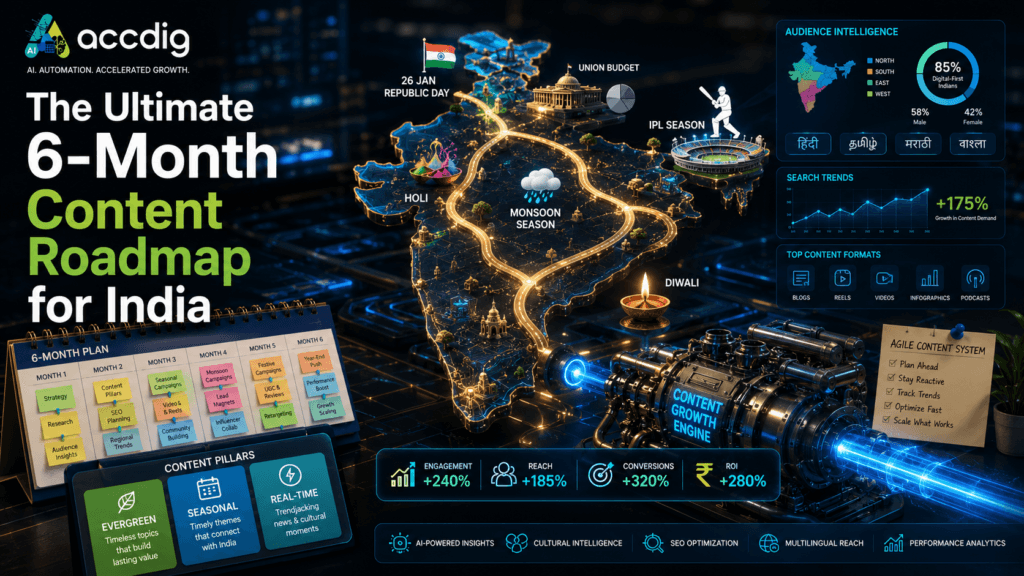
This content roadmap strengthens seasonal content planning and improves audience engagement. This is the additional support system that is added to your 6-Month Content Plan. We are not just squashing holidays – we’re charting Intent.
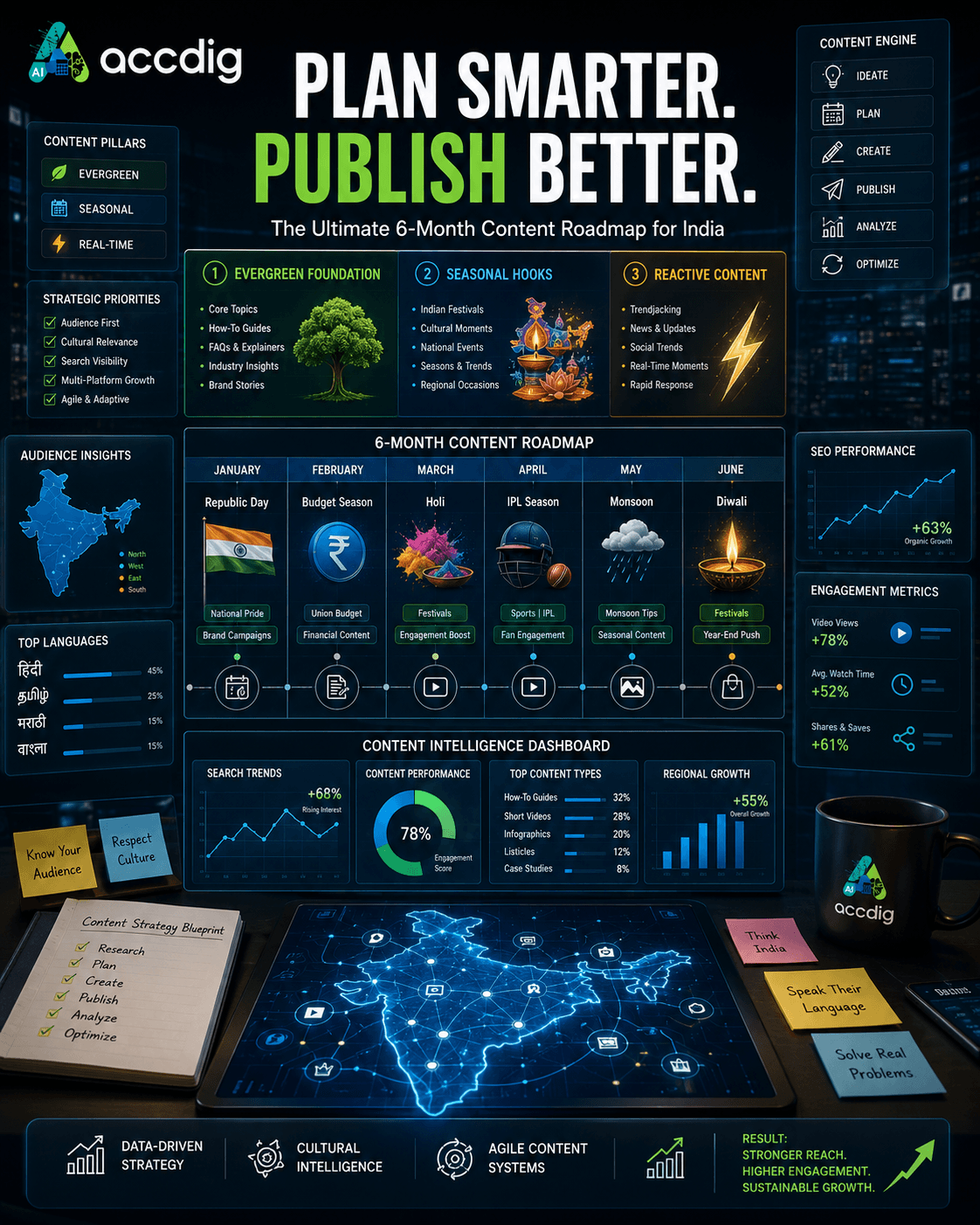
January:
January is a month of patriotic, saving and fresh beginning celebrations such as Republic Day, Sankranti/Pongal, end of year sales, etc. Content should be directed toward the goal setting, financial planning, cultural, and some “What’s Next?” content.
February:
February has emotional and financial goals with the holiday of Valentine’s Day, the Union Budget and the exam preparation. The content may be investment-related, financial analysis topics, education-related and relationship-related.
March:
March is a month of celebration and compliance (urgency).Holi and fiscal year end brings March joy and compliance urgency. Tax guides, compliance checklist and business planning content are popular applications for audiences that are looking for tax planning and reflection.
April:
April is a month of optimism and pride in the region with festivals such as Gudi Padwa, Ugadi, Baisakhi or the IPL season. Community building, region campaigns and high engagement sport based strategies should be included in the content themes.
May:
May is all about travel, health and social outings, as summer vacations and hot weather are common along with the potential of election buzz. The areas you can explore content include travel insights, health tips, seasonal solutions and social commentary.
June:
Monsoon season and Father’s day are all reminders to think of the past, and of planning the future, in June. Career guidance and educational planning, nostalgia marketing and back to school themes should be the focus of content.
Phase II: The Content Tier System 3 Backlogs to the Max.
It’s crucial that a strategic Content Roadmap India is flexible. There are three different content backlogs which must co-exist. This is the secret to have an agile SEO Content Strategy India.
1. The Highway (The Evergreen Foundation).
- Objective: Obtain consistent organic traffic, be an authority (E-E-A-T) and attract links.
- Model: Pillar content, Product tutorials, etc. lists of what people call X accountable descriptions etc.
- Strategy: No expired topics (They address the kingpin of audience pain). In the eyes of a client of the FinTech, it could be How to open a Demat Account in India or Complete Guide to ELSS Investments. These are SEO wins you can’t do without.
2. The Seasonal Hooks (The Off-Ramps).
- Objective: To bring in high intent traffic to the best cultural and business times.
- Model: Festival Campaigns, Budget analysis, End of Season sales, Cricket/IPL themes.
- Strategy: This is where you will make the most of the above cultural calendar: Begin to plan 6-8 months before. The Diwali content that you are going to have should be prepared at the beginning of October. Use keywords that have a long tail, meaning they’re longer and more specific, like Best Diwali gift ideas for employees 2025.
3. The Reactive & Real-Time (The Potholes & Detours).
- Objective: To be relevant, part of the trending conversation and to drive engagement.
- Model:. Newsjacking, industry news, industry trends (memes, audio), quick reaction news.
- Strategy: It’s important to have a small group, or even a single individual, that focuses on the industry in their social media and news feeds. If you get a report from RBI that was recently made on digital transactions, you need to have anchor text, quick and a summary of information for your readers. This will make your brand new, fresh and human.
Micro-Case Study: I had once worked at a small agency, and had to do a small educational campaign was being prepared. In February, the Union Budget was announced and had a slight provision that impacted on their target sector. They placed a scheduled posting on hold and just less than 48 hours later posted an easy-to-digest, easy-to-digest video called “How the Budget Affects You. It led them 2 weeks on all their evergreen catalogues.
Lesson: Prepare to change direction.
Phase III: Implementation and Assessment- The Engine Test.
The best plan is nothing without an impeccable implementation. The last step in this Content Agencies Planning Guide is to concrete the tools and metrics.
A successful digital marketing strategy depends on aligning channels with audience engagement goals..
All the content does not have to be omnipresent.
- Blog/Website: This is most commonly used for Evergreen and long term Seasonal material. Dwelling upon the SEO, authoritative linking and desktop/tablet readability. Suggestion Internal Links: Suggest the internal link you wish to your template in SEO Content Strategy or Advanced SEO Guide.
- Social Media (Instagram/Reels): This will primarily be employed for Reactive content, cultural hooks, and for short-form Seasonal content. Listen, watch and follow trends.
- Email/WhatsApp: At high value (e.g., “tax deadline alert”) and urgent content (e.g., Reactive content) is distributed at high value and personalized.
Busting the Myth of the Perfect Content Calendar.
Myth: “We must publish daily to win.”
Daily publishing doesn’t necessarily mean growth. Quality and consistency are more important – three valuable, well-targeted posts per week can prove to be more effective than seven posts with a clichéd message.
Myth: “Only Hindi/English works.”
Limited language use (only Hindi/English) restricts opportunities for growth. Regional and vernacular content is gaining growing influence and is a channel that allows a brand to reach audiences and markets that are not yet reached.
Myth: “SEO is just keywords.”
In today’s world search optimization is more than just keywords. Now search engines are foregoing User Experience and having a more meaningful content that is helpful to users, in addition to the E-E-A-T (Experience, Expertise, Authoritativeness, and Trustworthiness).
Indian Market Critical Metrics.
Don’t just ignore them, but pay attention to them especially in terms of a Marketing Managers Content Roadmap:
- Time on Page (Vernacular vs. English): This will answer the question, “is the content that you’re transcreated actually resonating with the interest of the regional audience or not?
- Conversion Path Analysis: What percentage of people who watched your “Union Budget Analysis” downloaded the whitepaper?What percentage of your viewers of your “Union Budget Analysis” downloaded the whitepaper? Or registered to receive the webinar? Not counting on clicks, measure ROI.
- Retention Rate (Video): It is important that you have at least 70% retention rate in the first three seconds in the short-term. If you don’t hit it, the hook isn’t working!
Conclusion: It is Time to Change Gears.
This is the new shape of a powerful culturally-informed, and extremely strategic 6- month Content Roadmap. The fear of blank page and the fear of the deadline needs to be superseded.
Planning is not ‘hardcore’ but a good map that is very detailed but still allows for some strategic short cuts. Ahead of schedule with making changes when a new viral trend emerges or SEBI announces an important policy change. Most important, however, be sure your Evergreen foundation and Seasonal Hooks are loaded.
Your listeners want to see real, genuine, and credible information that will impact their life, their concerns, and their dreams. Make them think that you have some credibility. So let’s get ready to start that road trip and you’re going to drive the high performing content engine before the New Year.
Follow and DM our page on Facebook for our free 2026 Indian Content Calendar Template — your mapping tool to master content in India’s most dynamic year yet.